Escape Rooms vs Board Game Experiences: Which Is Right for Your Team?
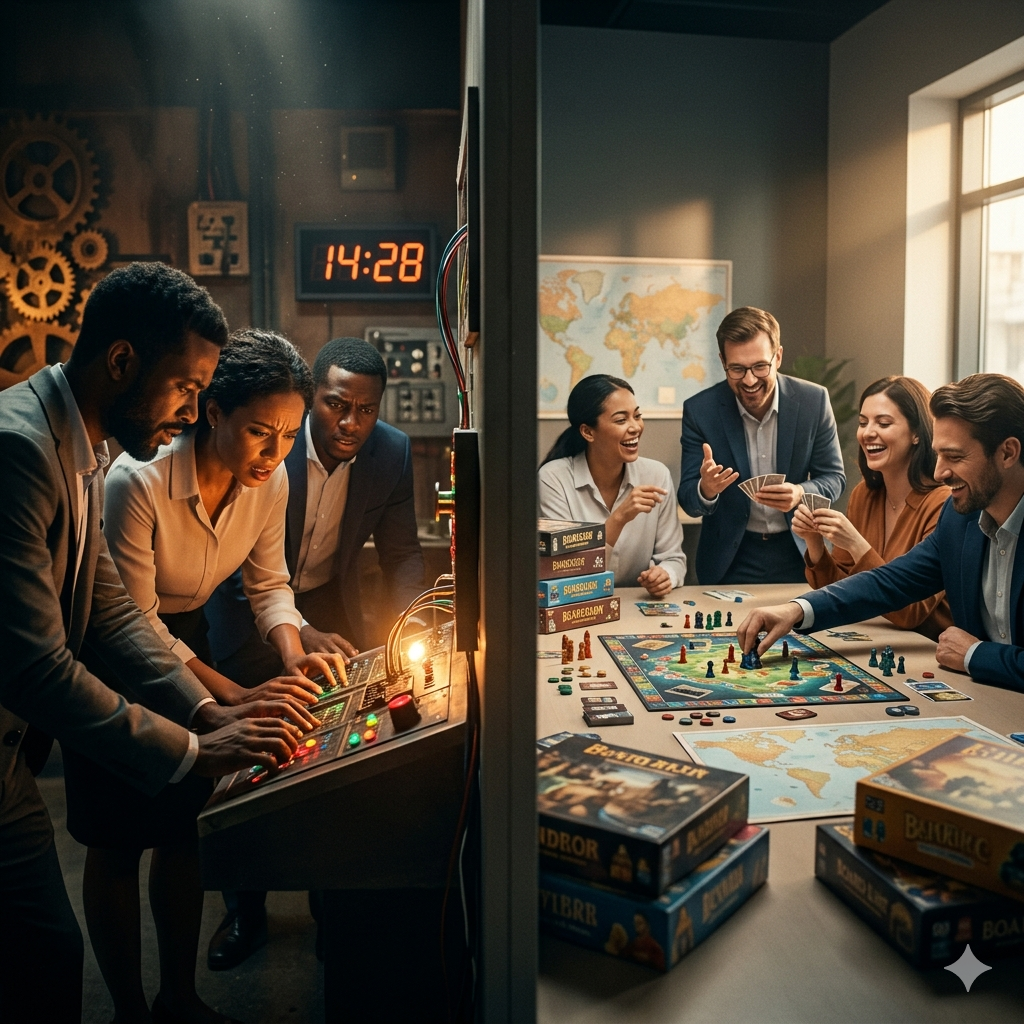
Escape Rooms and Board Games are both great options for a team event but which is the ‘best’ choice for your team
Both are brilliant options for team events. They're also quite different in ways that matter when you're choosing. Here's an honest comparison.
If you're deciding between an escape room and a board game experience for your next team event, you're already thinking in the right direction. Both are far more interesting and fun than a dinner out, team drinks or trip to the bowling alley or indoor golf.
However they suit different teams, goals, and occasions. Here's how to think it through.
The core difference
Escape rooms are a single, shared challenge. Your team is locked in a themed room (physically or virtually) and has to solve puzzles, find clues, and work out how to "escape" within a time limit, usually 60 minutes. Everyone works on the same problems with a common goal.
Board game experiences are more fluid. Game cafes can provide a variety of games or a professional host can bring a selection of games to your space. A dedicated host facilitates game selection and rules explanation and runs the session. You might play one longer game or several shorter ones. The experience adapts to your group.
Both involve problem-solving, communication, and collaboration. How they deliver that looks quite different.
Group size
Escape rooms: Escape rooms are generally designed for 4 - 8 people and this doesn’t really change whether at an Escape Room location, playing online or with a host running the experience for you. This is their biggest practical limitation. If you have 20 people, you either need multiple rooms (which splits the group) or look for operators who run larger-format experiences.
An alternative for teams with limited or varied availability is to run smaller groups across the team through the same escape room matching people’s availability, with a debrief after with everyone to see which team did ‘best’ and for the whole team to share their experiences in finding the solution.
Board game experiences: Much more flexible on group size. Games can be tailored for smaller groups, to team events or large groups of 30+, with games that scale or multiple tables running simultaneously.
Winner for large groups: Board game experience.
Winner for small groups: Either works well.
Time required
Escape rooms: Generally, run for exactly 60 minutes, with 15–20 minutes either side for briefing and debrief. Total time commitment is roughly 90 minutes.
Board game experiences: Different games and approaches can be chosen to meet the aim of the event. You can have a couple of lighter games for an hour over a lunchtime or choose more games or longer to play certain games for a couple of hours or an half day off site. Design a tournament or even a league for regular catch ups.
Winner for time flexibility: Board game experience.
Winner for a quick contained experience: Escape room.
Location and logistics
Escape rooms: Traditional escape rooms require your team to travel to a venue. This adds time and coordination - not ideal if you have a large team, people coming from different offices or remotely located teams.
Virtual escape rooms or hosted escape rooms remove this constraint entirely by either running online which is a great solution for remote teams, or hosted escape room experiences come to you and your team.
Board game experiences: Game cafes are available but often struggle with larger teams and you have to go to them. With a hosted event the game comes to you and is tailored to your needs. Set up is managed and you have a dedicated host to ensure everything runs smoothly. Online versions of games also now exist. Hosted events can assist with the access or logistics of online games or provide a ‘translated’ version of in person games for your team.
Winner for convenience: Tied – both can involve travel to a game cafe or escape room, however both can be provided online with a hosted event.
Winner for remote/hybrid teams: Tied — both work online.
Energy and intensity
Escape rooms: Higher intensity by design. There's a countdown clock, puzzles that need solving, and there's a defined win/lose outcome. For teams that enjoy that pressure, it's exhilarating. For teams that are already running hot (coming off a stressful project, dealing with change, or with any interpersonal tension) it can amplify rather than release that energy.
Board game experiences: Adaptable energy. A competitive strategy game can generate real intensity. A word game or cooperative game can be gentle and funny. Party or dexterity games are a lot less stressful and more focussed on the fun element. The host reads the room and adjusts. You get to choose the mood you're creating.
Winner for high-energy teams: Escape room.
Winner for mixed or uncertain energy levels: Board game experience.
Inclusivity of all personalities
Escape rooms: Some people will naturally take the lead on puzzle-solving; others may feel like passengers. Competitive team members might push hard in ways that create pressure on others. This can be exacerbated with larger groups (>6) or if there is no host. A hosted escape room is able to be responsive to the players and be inclusive of all participants.
Board game experiences: A skilled host actively manages inclusion. Different games reward different strengths — analytical thinking, creativity, communication, pattern recognition — so everyone has a moment where they're genuinely contributing. Nobody gets left behind.
Winner for mixed groups: Board game experience.
Winner for teams that love a puzzle challenge: Escape room.
Replayability
Escape rooms: Once you've done a specific room, you can't really do it again as you know the puzzles. There are usually other rooms available, but you're always hunting for a new experience.
Board game experiences: The number of games available is enormous these days with a wide variety of types of game. Every session can be different. Or if your team finds games which they love this could become a regular event with teams trying to ‘get revenge’ for the result last time. This can even go as far as to have a league table of results.
Winner for repeat events: Board game experience.
Cost
Escape rooms: Traditional venues typically charge per person ($40–$50 per head), which works out reasonably for small groups but adds up for larger teams. Private hire for a whole venue costs more.
Board game experiences: Board game cafes generally run cheaper per head but they usually are focussed on smaller groups and have less direct support. The Travelling Game Café offers packages from $300 for a lunchtime session, scaling with group size. For the level of facilitation, setup, and flexibility included, this represents strong value — particularly compared to venues with per-head pricing.
Winner on cost for large groups: Board game experience tends to offer better value as group size grows.
The good news: you don't have to choose
At The Travelling Game Café, we offer both. Board game experiences and escape room experiences both in person and online.
Get in touch and we'll help you work out which format (or combination) is right for your team.