What to Expect from a Board Game Team Building Experience (First-Timer's Guide)
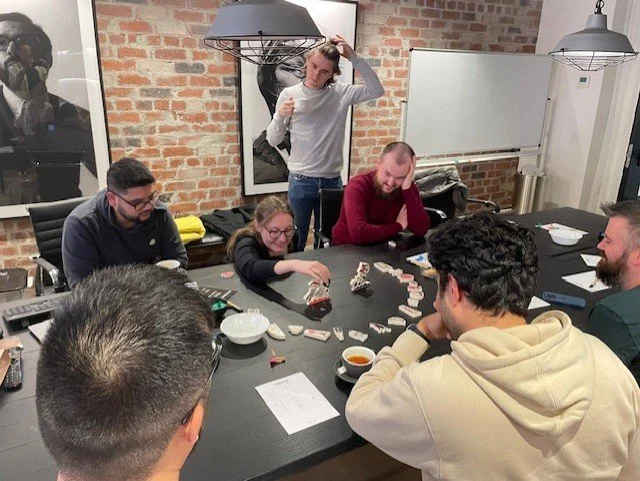
Never booked a hosted board game experience before? Here's exactly what happens from the moment we confirm your booking to the moment we pack up and leave.
If you're considering a board game team building session and you're not quite sure what it involves, this is for you.
Boardgames have become increasingly popular over the last decade either being referenced on shows or by cast members to actually being the central premise of shows like The Traitors.
However, running your own Board Game event can be challenge for a number of reasons; what games to play and who is paying for them? Who teaches the rules? Will it be too complex?
A hosted Board Game event can allow your team to experience all of the benefits with none of the downsides, but how does a hosted event work and what exactly does it entail?
Before the session: what we sort out together
Once you get in touch, we'll have a brief conversation (by email or phone, whatever's easier) about a few things:
Your group. How many people, what's the general energy of the team, and whether there are any dynamics worth knowing about. A team that's just come off an intense project sprint needs a different approach than a group of new starters meeting for the first time.
Your goals. Do you want pure fun, or are you hoping the session does some specific work; helping a new team gel, marking a milestone, giving people a reason to decompress? There's no wrong answer and knowing this helps us guide you to the best choices for the team.
Logistics. We'll confirm the date, time, location, and how long you'd like the session to run. We come to you, so we just need an address and a suitable space; a meeting room, a breakout area, or a section of the office floor all work fine.
Game selection. We'll suggest a few options based on your group and you'll have final say. Don't worry if you don't know board games that's our job.
On the day: arrival and setup
We arrive before your team does. Typically 20-30 minutes early, depending on the size of the session.
By the time your team walks in, tables are arranged, games are set up, and everything is ready. There's no waiting around, no one scrambling with rulebooks, no "we'll get started in a minute" while someone works out where the components go.
This matters more than it sounds. The first two minutes of any team event sets the tone. Walking into something that looks organised and ready signals that this is worth your time.
The session itself: how it flows
Introductions (5 minutes or less). Your host will introduce themselves, briefly explain the format, and set the tone; warm, relaxed, and clearly low-pressure. No mandatory sharing circles. No awkward icebreakers before the actual icebreaker.
Rules explanations. Your host will teach each game before you play it. We choose games specifically because they can be explained quickly and clearly. Most games we use can be up and running in under five minutes of explanation. You don't need to know anything in advance.
Gameplay. This is the main event, and it usually sounds roughly like: laughter, mild arguments about rules (lovingly resolved), someone declaring they've developed a strategy, that strategy immediately failing, more laughter.
Games are run in rounds or full sessions depending on the format. For longer events, we'll move between different games; lighter and faster-paced, then something with a bit more depth, for example. For larger groups we can set up a number of games around the space and with groups moving between these so no one is sitting around waiting longer than necessary.
What about people who say they're not into games?
This comes up constantly, and it's a legitimate question. Every group has someone who's cautious about this.
A few things help. First, we choose games that are genuinely accessible nothing with complex rules that punish beginners or reward long-term enthusiasts at the expense of everyone else. The games we use for corporate events are specifically chosen because they're easy to pick up and fun on the first play.
Second, the host's job is to make sure everyone's included without making anyone feel put on the spot. There's a real difference between "it's your turn" in a way that creates pressure and "it's your turn" in a way that feels like an invitation. A good host knows how to do the latter.
Third, self-declared non-game people are often the ones who end up most engaged. We've seen it happen many times. Once the stakes feel genuinely low and the activity is clearly fun, most of that resistance just dissolves.
Pack-down and close
When the session ends, we handle everything. Games go back in their boxes, boxes go back in our bags, tables get returned to where they were. We usually clear everything in 10-15 minutes.
If there are prizes involved (tournaments, team challenges), we distribute those at the close and give the host a moment to wrap up with a few words.
You're left with a team that's had a good time together and an office that looks exactly like it did before we arrived.
Frequently asked questions
Do we need to provide anything? Just space and people. We bring everything else. If you'd like to provide drinks or snacks (which the team can have during play), we can coordinate timing with that.
What's the minimum and maximum group size? We work with groups from around 6 upward. For larger events (30+), we can run multiple tables simultaneously and include tournament structures.
Can it work in a small meeting room? Yes. We're used to adapting to different spaces. Ideally we'd want enough table space for people to sit comfortably around a game, but we can work with a lot of different configurations.
What happens if someone has a work emergency and has to leave mid-session? Games are designed to accommodate this. We can adjust the group or continue without interruption.
Can we add our own theme or branding? Yes. We can incorporate custom elements for larger events. Ask us about this when you get in touch.
Book your first session
We're based in Melbourne and come to you — office, co-working space, or wherever your team is gathered. Sessions start from $300.